
Over the past fifteen years, I’ve watched the rainfall patterns across Australia become increasingly erratic. What used to be predictable seasonal rhythms – the summer monsoons in the north, reliable winter rains in the south, dry spells in between – now feels less certain. The shifts aren’t dramatic year to year, but when you step back and look at a decade of data alongside the gutters, foundations, and gardens I’ve worked on, the pattern becomes clear. Properties are experiencing longer dry periods interrupted by more intense rainfall events. That combination creates a specific set of stresses on residential structures and land that most homeowners don’t anticipate until something fails.
The practical consequence is that homes built for yesterday’s climate are now operating in conditions they weren’t designed for. A roof that handled moderate, consistent rainfall now faces torrential downpours followed by months of dryness. Soil that expanded and contracted in predictable cycles now moves unpredictably. Gutters, drainage systems, and foundations all respond differently when the rhythm changes. I’ve seen cracking patterns in concrete slabs that would have been rare ten years ago, and I’ve also seen gutters overflow in ways that older designs simply didn’t account for.
Longer Dry Spells and Foundation Movement
The extended dry periods are perhaps the most visible problem at ground level. When soil dries out significantly, it shrinks. Clay soils do this more dramatically than sandy ones, but all soils lose volume as moisture leaves. In areas where rainfall used to be more frequent and consistent, this is becoming a real issue. I’ve inspected homes where the soil around the perimeter has dropped several centimetres over a season, creating gaps between the foundation and the ground. These gaps don’t just look concerning – they allow water to pool differently when rain does come, and they can affect how the foundation itself settles.
The cracking I mentioned earlier typically appears in concrete slabs and in the lower sections of brick veneer. It’s not always structural in the immediate sense, but it signals movement. A slab that was stable for twenty years might develop a long crack running across it because the soil beneath has shifted. The crack itself might not be dangerous, but it’s a sign that conditions have changed. Once you see that kind of movement, you need to think about drainage, about whether gutters are directing water away from the house effectively, and whether the surrounding soil needs attention.
What I’ve noticed is that homeowners often don’t connect the dots between a dry summer and foundation cracks that appear months later. The damage happens during the dry period, but it becomes visible after the next wet spell when the soil reabsorbs moisture and expands unevenly. By then, the crack is already there.
Intense Rainfall and Drainage Failures
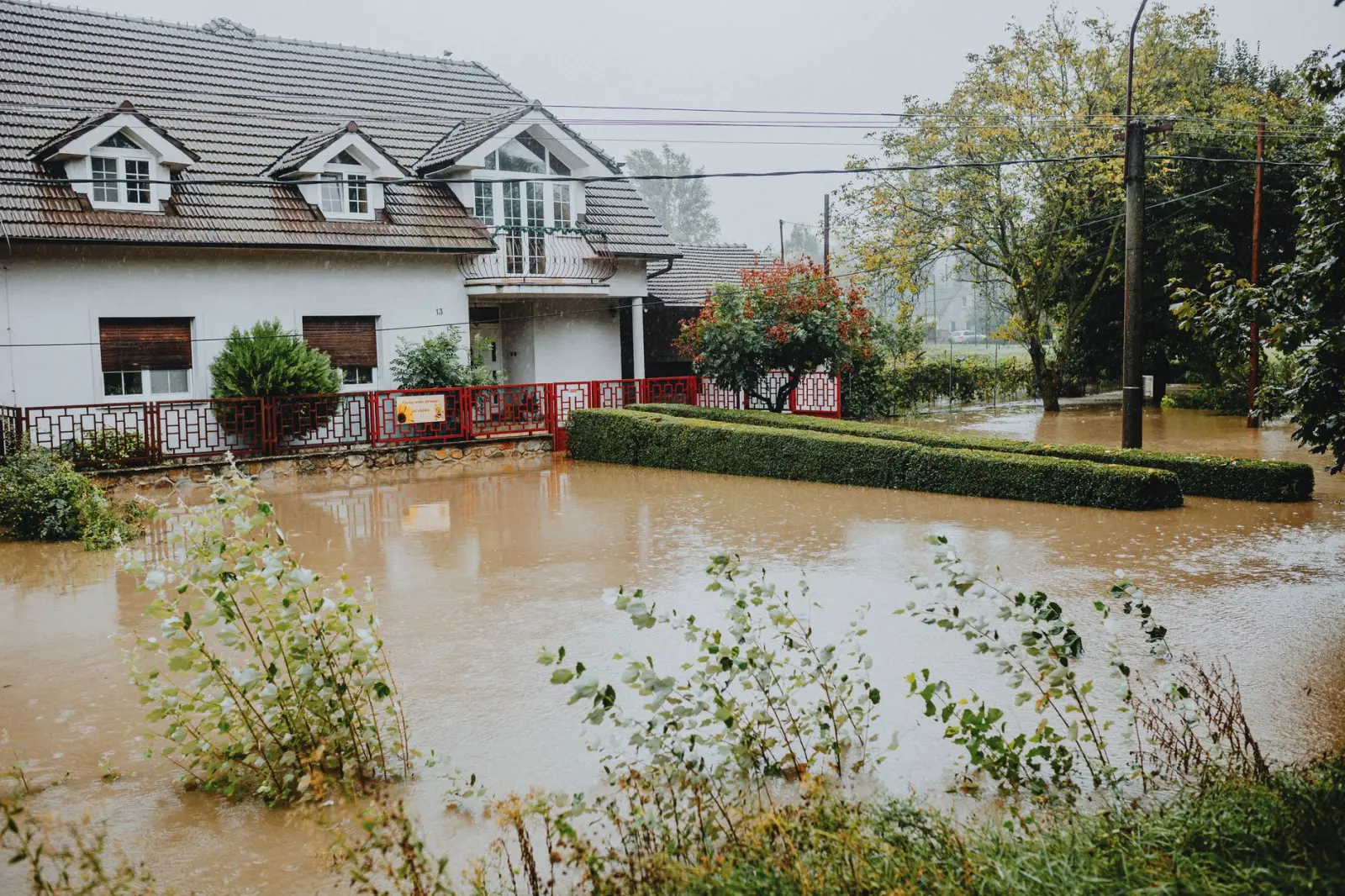
On the other end, when rain does come, it often comes harder and faster than older drainage systems were designed to handle. I’ve been called out to properties where water is pooling in unexpected places – not because the gutters are blocked, but because the volume of water arriving in a short time simply exceeds what the system can process. Downpipes that used to manage moderate flow now struggle. Ground-level drainage that worked fine for gentle, sustained rain becomes inadequate for a heavy storm that delivers several centimetres in an hour.
The real problem isn’t always the gutters themselves. It’s often what happens at ground level. Drainage pits that used to stay dry for months are now dealing with water more frequently. Soakage areas that relied on soil permeability are becoming overwhelmed. I’ve seen situations where water that used to drain away harmlessly now finds its way into basements or creates boggy patches that stay wet for weeks. The ground itself has changed – compacted over decades, sometimes with less vegetation to help absorb and filter water – so it doesn’t handle sudden volume the way it once might have.
Vegetation Stress and Garden Instability
Trees and shrubs respond to these shifts in ways that affect the stability of soil around them. Established trees that relied on consistent moisture patterns are now experiencing stress during longer dry periods. When a large tree is stressed, it draws water from the soil more aggressively, which accelerates shrinkage around its root zone. I’ve seen cases where a tree that had been stable for decades suddenly contributes to subsidence because the dry conditions pushed it into survival mode.
At the same time, the intense wet periods can cause problems for plants that prefer drier conditions. Lawns and garden beds that are used to a certain moisture rhythm are now experiencing waterlogging they’re not adapted to. Root rot becomes more common. Fungal issues increase. The garden doesn’t just look different – it’s structurally stressed, and stressed vegetation doesn’t hold soil together as effectively.
What I’ve observed is that properties with mature, well-established gardens tend to weather these changes better than newer properties with young plantings. The established root systems provide stability and help moderate soil moisture. Newer gardens with shallow-rooted plants or sparse vegetation are more vulnerable to both the dry spells and the intense wet periods.
Gutters, Downpipes, and System Adequacy
The older I get, the more I appreciate a well-designed gutter system, and the more I see how inadequate many of them have become. A gutter that’s perfectly adequate for moderate, steady rainfall can fail spectacularly in a heavy downpour. I’ve watched water cascade over the edge of gutters that looked clean and properly installed, simply because the volume of water arriving exceeded the system’s capacity. The gutter size and the downpipe diameter were designed for conditions that no longer exist.
The fix isn’t always obvious. Sometimes it’s as simple as ensuring downpipes aren’t blocked and that water is directed far enough from the house. But sometimes it means the system itself needs to be reconsidered. Larger gutters, additional downpipes, or improved ground-level drainage might be necessary. I’ve also seen properties benefit from simple additions like rain gardens or permeable paving that absorb and filter water before it becomes a problem.
What’s important to understand is that this isn’t about being caught unprepared by a single extreme event. It’s about the system being inadequate for the new normal. A gutter that fails once in a hundred years is acceptable. A gutter that overflows every few years is signalling that conditions have changed and the system needs to adapt.
After years of working on homes across different regions, I’ve come to see these rainfall pattern shifts not as isolated weather events but as a new set of baseline conditions. The homes that fare best are the ones where owners have noticed the changes and made adjustments – better drainage, attention to soil movement, vegetation management, and gutter adequacy. It’s not dramatic work, but it’s the difference between a property that remains stable and one that gradually develops problems that become expensive to address.