
Australian cities weren’t designed for a low-carbon future. They were built around cheap energy, dispersed settlement patterns, and the assumption that cars would solve mobility forever. That foundation doesn’t disappear overnight, and the transition we’re seeing now isn’t a simple retrofit. It’s a collision between inherited infrastructure and new economic realities.
I’ve watched this play out across multiple cities over the past decade. The constraints are physical, not just political. A sprawling suburb built thirty kilometres from the CBD can’t suddenly become transit-oriented. The roads are already there. The lot sizes are already locked in. The utility networks follow patterns established fifty years ago. These aren’t minor inconveniences – they’re the actual skeleton of how people live and move.
What’s becoming clear is that the low-carbon transition in Australian cities will look fundamentally different from the narrative of “green cities” we often hear. It won’t be a wholesale redesign. It will be a series of practical adaptations working within existing constraints, some of which will succeed and some of which will plateau.
The Transport Problem That Defines Everything
Transport accounts for roughly a quarter of Australia’s emissions, and in cities, personal vehicles dominate that share. The issue isn’t that Australians don’t want alternatives – it’s that the urban form makes alternatives genuinely difficult for most people.
Sydney, Melbourne, and Brisbane have invested heavily in public transport expansion, and the numbers show uptake. But the geography works against density. Median house prices correlate directly with distance from the CBD, which means people with families and mortgages often live where transit is thin. A parent in an outer suburb can’t reliably get two kids to school, themselves to work, and a third child to soccer practice on buses. The maths doesn’t work. The car isn’t a preference – it’s a necessity given the spatial reality.
Electric vehicles are being presented as the answer, and they do reduce emissions at the tailpipe. But they don’t solve congestion, don’t reduce the land consumed by parking, and don’t change the fundamental inefficiency of moving one or two people in a two-tonne vehicle. They’re a transition tool, not an endpoint. What I see happening is a slow shift toward EV adoption in affluent areas where people can afford the upfront cost and have off-street charging, while outer suburbs remain dependent on petrol vehicles for longer. That’s a real equity issue that doesn’t get discussed enough.
Where Density Actually Works
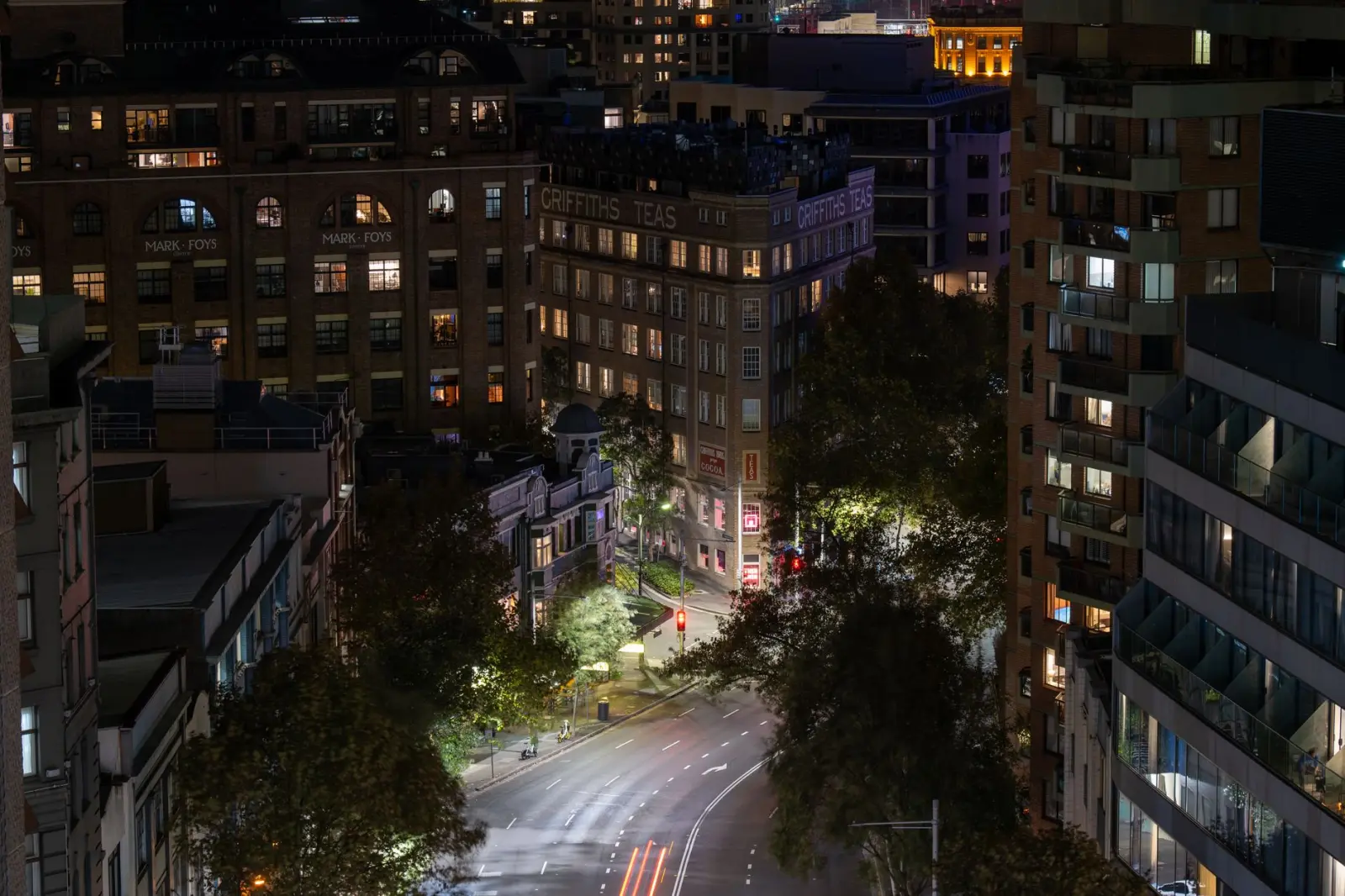
Inner-city precincts in major Australian cities have genuinely shifted. Places like inner Melbourne, inner Sydney, and parts of Brisbane now have walkable neighbourhoods with mixed-use development, reasonable transit access, and lower car dependency. These areas are expensive, which creates its own problems, but the urban form supports low-carbon living in a way outer suburbs simply don’t.
The catch is that density alone doesn’t guarantee low emissions. A high-rise apartment building in the city centre uses energy for heating, cooling, and water. The embodied carbon in construction is significant. The residents might walk to work but fly regularly for business. Density is necessary but not sufficient.
What I’ve observed is that inner-city areas are becoming increasingly selective about who can afford to live there. The people who benefit most from walkable, transit-rich neighbourhoods are often priced out. Meanwhile, people with lower incomes are pushed further out, where they’re forced into longer commutes and higher transport emissions. The low-carbon transition is inadvertently becoming a mechanism for spatial inequality.
Building Stock and Retrofit Reality
Australian homes are notoriously energy-inefficient. Poor insulation, single-glazed windows, and aging HVAC systems are the norm, not the exception. Retrofitting existing housing stock is essential for a low-carbon future, but the economics are brutal.
A comprehensive retrofit – insulation, windows, heat pump heating, solar – costs $30,000 to $60,000 per house. For a homeowner with a mortgage, that’s a significant barrier. Government rebates help, but they don’t close the gap entirely. Rental properties present an even worse problem. Landlords have no incentive to invest in efficiency improvements if tenants bear the energy costs. Tenants have no ability to make improvements they don’t own. That misalignment locks in inefficiency for decades.
What’s actually happening is that new construction is improving faster than existing stock is being retrofitted. New homes are built to higher standards, but they represent only a small fraction of the total housing stock. The bulk of Australian housing – the houses people actually live in – will remain relatively inefficient for another twenty to thirty years. That’s not a failure of technology. It’s a failure of economics and incentive structure.
Industrial and Commercial Transition
Manufacturing in Australian cities has already largely shifted offshore. What remains is concentrated in specific areas – food processing in regional zones, some light manufacturing in industrial precincts. The real energy demand in cities now comes from commercial buildings, retail, hospitality, and data centres.
Commercial buildings are responding faster than residential stock because the economics work differently. A business can justify a solar installation or a chiller upgrade based on energy savings. Landlords are beginning to recognize that efficient buildings attract tenants and command higher rents. That feedback loop creates actual incentive for improvement.
Data centres are a growing wildcard. They’re energy-intensive, and they’re locating in and around major cities because that’s where the network infrastructure and talent exist. Some are investing in renewable energy to offset their consumption, but the total demand is growing faster than the offset capacity. That’s a real constraint that doesn’t get much attention in the low-carbon narrative.
The Infrastructure Lock-In Problem
Australian cities are still connected to coal-fired power stations and gas distribution networks. The electricity grid is gradually shifting toward renewables, which is genuinely happening. But the gas infrastructure – pipes, meters, heating systems – will take decades to wind down. You can’t just turn off gas networks. People depend on them. The transition has to be managed gradually.
This creates a peculiar situation where cities are simultaneously investing in renewable electricity and maintaining gas infrastructure. Both are necessary in the short term. But it means that the low-carbon transition isn’t a clean break. It’s a messy, overlapping period where old and new systems coexist.
Water systems present similar constraints. Australian cities have invested heavily in recycled water and stormwater harvesting, which reduces demand on distant reservoirs. But the infrastructure to deliver recycled water to individual properties is expensive and only partially deployed. Most households still rely on mains water, which requires energy for treatment and pumping. Again, the transition is partial and slow.
What Actually Changes
The cities that are moving fastest toward lower emissions aren’t doing it through grand master plans. They’re doing it through incremental decisions that align with economic incentives. Solar adoption is driven by cost parity with grid electricity. EV adoption is driven by lower running costs and improving range. Apartment development in inner cities is driven by land value and demand for walkable neighbourhoods.
The low-carbon transition in Australian cities will be uneven. Inner precincts will move faster. Outer suburbs will move slower. Renters will move slower than owner-occupiers. Commercial buildings will move faster than residential. Some sectors – electricity generation, for instance – will decarbonise relatively quickly. Others – transport, heating, industrial processes – will take much longer.
The real constraint isn’t technology. It’s the spatial, economic, and social structure of cities as they actually exist. That structure changes slowly. Expecting Australian cities to transform into low-carbon models within a decade is unrealistic. Expecting meaningful progress within two decades is reasonable, but only if we’re honest about what that progress looks like – incremental, uneven, and constrained by the cities we’ve already built.