
After spending years working on homes across Australia, I’ve watched the shift toward full electrification move from fringe interest to something genuinely common. What strikes me most is how different these homes actually are from what people imagine. There’s no single template. A fully electrified home in Perth looks and functions differently from one in Melbourne or Sydney, shaped by climate, grid capacity, existing infrastructure, and how much the owner was willing to spend upfront.
The first thing you notice walking into an electrified home is what’s not there. No gas meter on the wall. No gas lines running through the kitchen. No pilot light smell in the laundry. But the absence of gas is only the surface-level change. The real work happens in how electricity is distributed, stored, and managed throughout the house.
The Electrical Backbone
Most electrified homes I’ve worked on have upgraded their main switchboard. This isn’t always obvious to a visitor, but it’s essential. A standard Australian home might arrive with a 60-amp or 80-amp service, which works fine for lights, appliances, and air conditioning running separately. Once you layer in a heat pump hot water system, induction cooktop, and an electric vehicle charger, that capacity gets tight quickly. Most electrified homes end up with 100 amps or higher, and increasingly, 3-phase power if it’s available and the budget allows.
The wiring itself often needs attention too. Older homes might have single-phase supply adequate for gas heating and basic cooking. Electrified kitchens with induction cooktops draw significant current, and if you’re charging a vehicle at home, that’s another 7 to 10 kilowatts during peak charging. I’ve seen homes where the existing wiring couldn’t handle it, and the electrician had to run new circuits from the switchboard to the kitchen and garage. It’s not glamorous work, but it’s the foundation everything else sits on.
Heating and Hot Water
This is where electrification becomes visible. Heat pump hot water systems are now standard in new electrified homes. They look like a regular hot water tank but with a compressor unit attached or integrated. The system extracts heat from the air and uses it to warm water, which is far more efficient than resistance heating. In Australian climates, they typically run at 3 to 4 times the efficiency of electric resistance heating.
What people don’t always realize is that heat pumps perform differently depending on temperature and humidity. In a Brisbane summer, they’re incredibly efficient. In a Melbourne winter, they still work, but they work harder and use more electricity. Many homes I’ve seen have a backup resistance element that kicks in on very cold days or when demand spikes, which adds to running costs but ensures reliability.
Space heating varies dramatically by region. In warmer parts of Australia, many electrified homes rely on reverse-cycle air conditioning for heating. In cooler areas like Tasmania or the southern highlands of NSW, some homes have installed electric heat pumps or even retained wood heaters as backup. A few have gone fully electric with ducted heat pump systems, though these are more common in new builds than retrofits because of installation complexity.
Cooking and Kitchen Load
Induction cooktops are almost universal in new electrified homes now. They’re fast, efficient, and give precise temperature control. But they’re also a significant electrical load. A dual-zone induction cooktop running at full power can draw 7 to 8 kilowatts. If you’re also running the oven and the dishwasher, that’s a real demand on the home’s electrical system. I’ve been in homes where the owner installed a 32-amp circuit just for the cooktop, which is standard practice now.
The kitchen itself often reveals how carefully the home was planned. Well-designed electrified kitchens have dedicated circuits for major appliances, separate from general lighting and bench power. The electrical layout tends to be tidier than in older homes because everything was installed at once rather than added piecemeal over decades.
Solar and Battery Storage
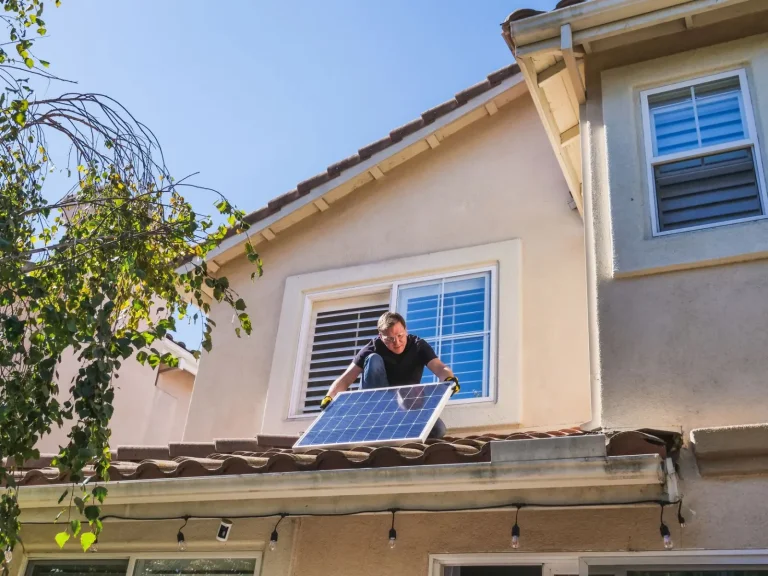
Most electrified homes I’ve encountered have rooftop solar. It’s not mandatory, but it makes economic sense. A typical installation is 5 to 10 kilowatts, depending on roof space and budget. What’s interesting is how these systems are integrated. Modern homes have a hybrid inverter that manages solar production, grid draw, and battery charging simultaneously. The system decides whether to use solar energy immediately, store it in a battery, or send it back to the grid.
Battery storage is becoming more common but remains expensive. A 10-kilowatt-hour battery system costs $10,000 to $15,000 installed, which means many homeowners skip it initially. Those who do install batteries typically use them to maximize self-consumption of solar energy and provide backup during grid outages. I’ve noticed that homes with batteries tend to have more sophisticated energy monitoring, with apps showing real-time consumption and solar generation.
The reality of solar and batteries in Australian homes is that they’re economically driven. Homeowners install them because electricity prices keep rising and the payback period is shrinking. Environmental motivations exist, but the financial case is usually the primary driver.
Electric Vehicle Charging
An EV charger is now a standard fixture in electrified homes with a garage or carport. Most are wall-mounted 7-kilowatt or 11-kilowatt units. The installation requires a dedicated circuit from the switchboard, usually 32 or 40 amps depending on the charger rating. I’ve seen a few homes with 22-kilowatt chargers, but those are less common and require three-phase power.
What often surprises people is the interaction between EV charging and other high-load appliances. If you’re charging the car at 7 kilowatts and running the heat pump hot water system at the same time, that’s 10 to 12 kilowatts total. If your solar isn’t generating enough, the grid has to supply it all, which can trigger demand charges on some electricity plans. Smarter homes use timer functions to charge the vehicle during off-peak hours or when solar generation is highest.
Monitoring and Control
Most electrified homes have some form of energy monitoring. At minimum, a smart meter that tracks consumption in real time. Many have dedicated energy management systems that show which appliances are using power and when. Some integrate everything – solar, battery, EV charger, and major appliances – into a single app.
The monitoring systems vary in sophistication. Basic ones just show total consumption. Advanced systems can control charging times, optimize battery discharge, and even integrate with dynamic electricity pricing plans. I’ve been in homes where the owner barely looks at the data, and others where they obsess over it. The people who engage with monitoring tend to use less electricity overall, simply because they’re more aware of when and how they’re consuming it.
What Actually Works
After seeing dozens of these homes, certain patterns emerge. Homes that combine heat pump hot water, induction cooking, reverse-cycle air conditioning, and rooftop solar tend to have the lowest running costs and the most resilience. The combination makes sense thermodynamically and economically. Heat pumps are efficient, induction is precise, and solar offsets a significant portion of consumption.
What tends to underperform is oversized solar without battery storage. A 15-kilowatt system on a home that uses 20 kilowatt-hours per day will export most of its excess generation during the middle of the day when nobody’s home. Unless you have a battery or can shift consumption to daytime hours, that exported energy is worth less than what you pay for grid electricity in the evening.
The homes that struggle most are those where electrification was done piecemeal without considering the whole system. Someone installs an induction cooktop, then later adds solar, then later adds a heat pump, without thinking about how they interact. These homes often end up with inefficient circuit design, suboptimal solar orientation, or an undersized switchboard that limits what can run simultaneously.
The Practical Reality
Living in an all-electric home in Australia is unremarkable once it’s done. The daily experience isn’t dramatically different from a gas home. Water is hot, cooking is fast, the house stays comfortable. The difference is in the bills, the maintenance (no gas servicing), and the knowledge that the home isn’t dependent on gas supply or price volatility.
There are minor quirks. Heat pump hot water systems are noisier than gas systems. Induction cooktops require compatible cookware. EV charging overnight means a small hum from the charger. None of these are deal-breakers, just adjustments.
The real advantage becomes apparent over years. No gas safety inspections, no gas price increases, no pilot light repairs. Electricity prices rise too, but solar and efficiency improvements offset some of that. And if you’re charging an EV instead of buying petrol, the fuel cost comparison is stark.
What I’ve learned from these homes is that electrification isn’t a single decision. It’s a series of interconnected choices about heating, cooking, transportation, and energy generation. The homes that work best are the ones where someone thought about those connections upfront rather than treating each system as independent. That’s the difference between a home that’s simply all-electric and one that actually functions well as an integrated system.