
Most kitchens I walk into have a lighting problem that nobody notices until they’re trying to dice an onion at 6 PM or reading a recipe card at the counter. There’s usually one overhead fixture – often recessed lights scattered across the ceiling – that creates shadows exactly where you need to see, and bright spots where they don’t matter. The homeowner has learned to work around it. They’ve adjusted their prep routine, they cook earlier in the day, or they’ve added a desk lamp on the counter because it’s easier than fixing the actual problem.
The issue isn’t complexity. It’s that kitchen lighting gets treated as a single system when it should be thought of as three separate systems working together. Task lighting handles the work surfaces. Ambient lighting fills the room. Accent lighting, if you want it, adds visual interest. Most kitchens skip the first one entirely and wonder why they can’t see what they’re cutting.
Where the Real Work Happens
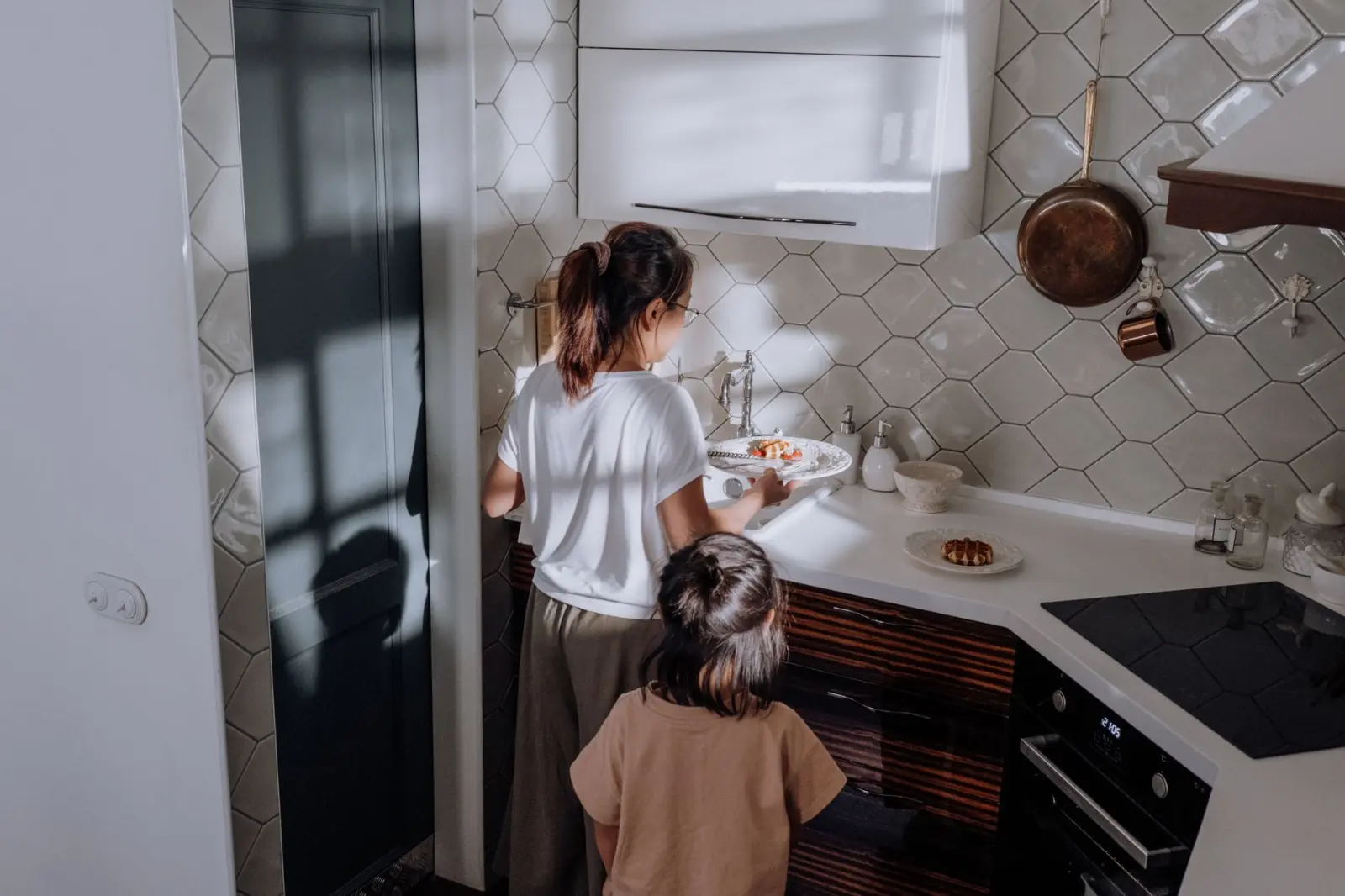
The countertops are where you spend your time in a kitchen. That’s where prep happens, where you read recipes, where you plate food. Yet I see kitchens where the counters are the darkest part of the room because the overhead lights are positioned to illuminate the floor or the center island, not the work surface directly in front of you.
Under-cabinet lighting changes this immediately. A strip of LED lights mounted on the underside of wall cabinets throws light straight down onto the counter where you actually need it. This isn’t decorative. It’s the difference between seeing what you’re doing and working by feel. The best placement is as far forward as the cabinet depth allows, which pushes the light beam down at an angle that covers the counter without creating a glare reflection off the backsplash into your eyes.
I’ve found that people often underestimate how much light they need at task areas. A kitchen counter isn’t like reading a book. You’re making quick decisions about doneness, color, texture. You’re working with sharp tools. The light needs to be bright enough that you don’t have to lean in or squint. Most residential kitchens benefit from under-cabinet strips that deliver at least 300 to 400 lumens across the main work zones. That’s roughly equivalent to having a bright desk lamp pointed at your work surface, which is what you’re actually trying to replicate.
The island presents a different problem. If you have one, it’s typically surrounded on all sides, so under-cabinet lighting alone won’t work. Pendant lights hung above the island are the standard approach, and for good reason. They light the work surface from above without creating the shadow problems that recessed ceiling lights do. The height matters. Too low and they obstruct sightlines and feel cramped. Too high and they stop being task lighting and become ambient lighting. Roughly 30 to 36 inches above the counter surface tends to hit the balance where they’re functional without feeling oppressive.
Ambient Light and How It Actually Behaves
Once your work surfaces are lit, you need general illumination so the rest of the kitchen doesn’t feel like a cave and so you can move around safely. This is where most kitchens go wrong by relying entirely on recessed ceiling lights.
Recessed lights work, but they work best when they’re positioned thoughtfully. In a typical rectangular kitchen, a single row of recessed lights down the center creates a bright stripe and dark edges. You get shadow zones along the walls and corners. If you’re standing at the sink or stove, the light is often behind you. I’ve watched people install recessed lights in a grid pattern thinking it solves the problem, but grids create their own issues – they can feel harsh and clinical, and they’re still prone to creating shadows depending on where you’re standing.
The better approach is to treat recessed lights as fill light, not primary light. Supplement them with other sources. A soffit with diffused lighting along the perimeter of the kitchen, or flush-mount fixtures in key locations, spreads light more evenly. Some kitchens benefit from a combination: recessed lights in the center of the room for general brightness, and a secondary source around the edges to eliminate shadows and dark corners.
Color temperature matters more than people expect. I’ve installed kitchens with warm white lights (2700K) and watched homeowners struggle to see colors accurately when they’re cooking. Kitchens function better with neutral white light (4000K) or cool white (5000K). It’s brighter-feeling, it shows food colors more truthfully, and it works better for reading recipes or checking ingredients. The trade-off is that it feels less cozy than warm light, but a kitchen is a workspace first.
Control and Flexibility
A kitchen that works in daylight might feel completely different at night. The same space that’s bright at 7 AM can feel dim at 7 PM. Dimmers on your ambient lighting solve this partially, but the real solution is having separate switches for different zones. Under-cabinet lights on their own circuit. Island pendants on another. Overhead ambient on a third. This lets you dial in exactly what you need for the task at hand.
I’ve also noticed that kitchens with good layered lighting tend to feel larger and more pleasant to spend time in. It’s not just about function. When you can see clearly, the space feels more open. When you’re not squinting or leaning in to see what you’re doing, you’re less tense. The kitchen becomes a place you want to be, not a space you tolerate.
The practical reality is that most kitchen lighting upgrades don’t require a full renovation. Under-cabinet lighting can be retrofitted into existing cabinets. Pendant lights can replace a single overhead fixture. Even repositioning or adding recessed lights is straightforward if you have attic access. The investment is modest compared to the improvement in how the space actually functions day to day. After years of watching people work in poorly lit kitchens, I’m convinced that lighting is one of the highest-return improvements you can make – and one of the most overlooked.